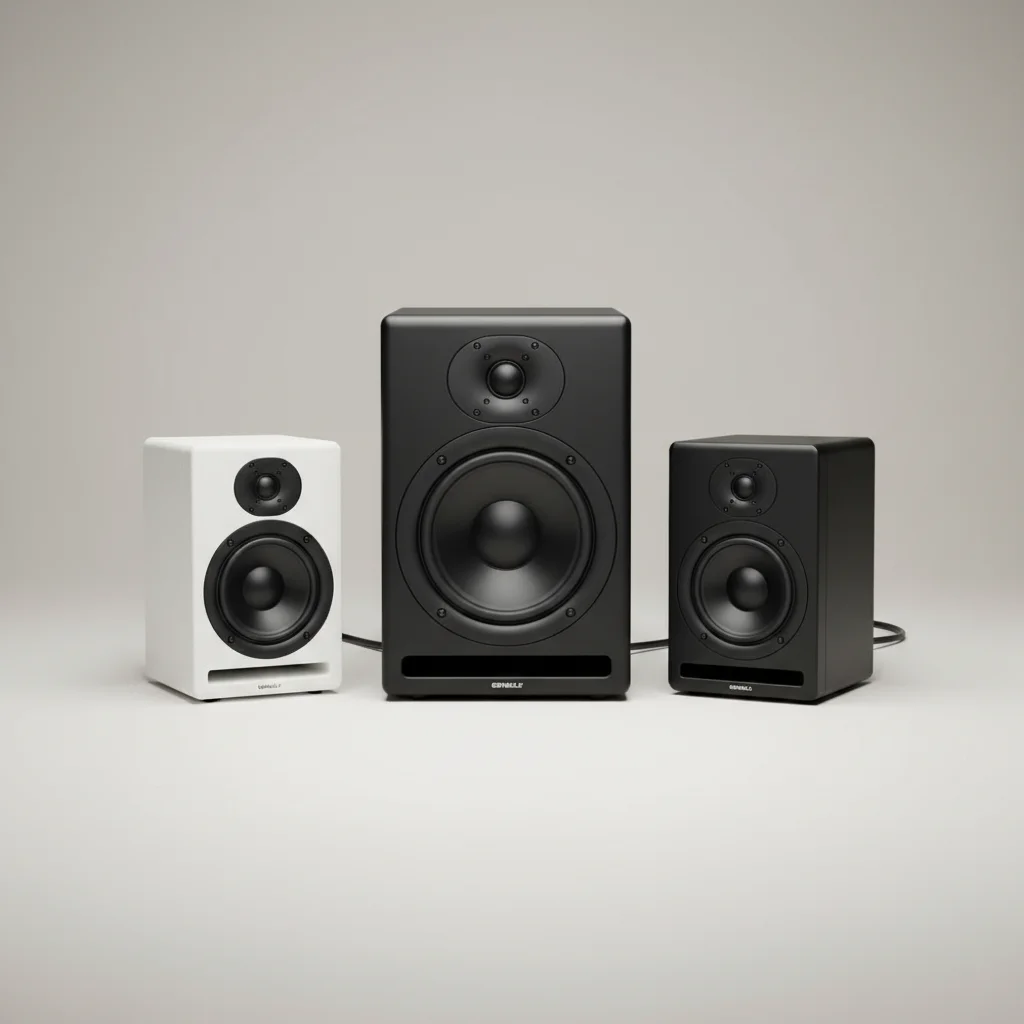
The Genelec 8351B is the best Genelec studio monitor for large rooms, offering exceptional power, precise imaging, and a wide sweet spot suitable for demanding acoustic environments. Large rooms present unique challenges for studio monitors, requiring significant power output, extended bass response, and accurate sound dispersion to ensure a consistent and detailed listening experience across the entire space. Genelec monitors are renowned for their robust build quality and advanced acoustic design, making them a top choice for professional studios and critical listening setups.
Quick comparison
| Model | Woofer Size | Max SPL | Frequency Response | Key Feature |
|---|---|---|---|---|
| Genelec 8351B | 8.5 x 4 inch oval | 116 dB | 32 Hz – 40 kHz | Coaxial design, SAM technology |
| Genelec 8361A | 10 inch oval | 118 dB | 30 Hz – 40 kHz | Higher SPL, extended bass |
| Genelec 1238AC | 15 inch | 121 dB | 29 Hz – 21 kHz | Main monitor, powerful |
What large rooms need from a studio monitor
Large rooms demand studio monitors with specific characteristics to overcome acoustic challenges and deliver accurate sound reproduction. Firstly, high SPL (Sound Pressure Level) capabilities are crucial. Monitors must be able to fill the expansive space without distortion, maintaining clarity and dynamic range even at higher volumes. This often translates to larger drivers and more powerful amplification. Secondly, extended bass response is essential. Large rooms can absorb low frequencies, making it difficult to perceive accurate bass without monitors capable of reaching deep into the sub-bass range. Monitors with larger woofers or integrated subwoofers are often preferred. Thirdly, controlled directivity and a wide sweet spot are vital. In a large room, listeners may not always be in the ideal listening position. Monitors that can maintain a consistent frequency response and stereo image across a broader area ensure that everyone in the room experiences accurate sound. Finally, room correction capabilities, such as Genelec’s SAM (Smart Active Monitoring) technology, are highly beneficial. These systems can analyze the room’s acoustics and automatically calibrate the monitors to compensate for anomalies, optimizing performance for the specific environment. Without these features, sound can become muddy, indistinct, or unevenly distributed, compromising critical listening and mixing decisions.
Detailed reviews
Genelec 8351B
The Genelec 8351B stands out as an excellent choice for large rooms due to its innovative coaxial design and powerful performance. Featuring an 8.5 x 4 inch oval woofer, a 5-inch midrange, and a 0.75-inch tweeter, all acoustically aligned, it delivers an incredibly wide and accurate sweet spot. This monitor boasts a maximum SPL of 116 dB and a frequency response extending from 32 Hz to 40 kHz, providing ample power and detailed sound across the entire spectrum. Its three-way design ensures dedicated drivers handle specific frequency ranges, resulting in superior clarity and reduced intermodulation distortion. The 8351B integrates Genelec’s SAM technology, allowing for precise room acoustic calibration, which is invaluable in large, potentially challenging environments. The monitor’s robust aluminum enclosure minimizes resonance, contributing to its transparent sound reproduction. Priced around $4,500 per monitor, the 8351B represents a significant investment, but its performance and advanced features justify the cost for professional studios.
Genelec 8361A
For even larger and more demanding environments, the Genelec 8361A offers a step up in power and bass extension. This monitor features a larger 10-inch oval woofer, a 5-inch midrange, and a 0.75-inch tweeter, all within a coaxial configuration. It achieves an impressive maximum SPL of 118 dB and extends its frequency response down to 30 Hz, providing a more impactful and accurate low-end presence crucial for large spaces. The 8361A also incorporates Genelec’s SAM technology, ensuring optimal integration with any room’s acoustics through automated calibration. Its larger drivers and more powerful amplifiers allow it to fill expansive rooms with detailed and dynamic sound without strain. The monitor’s advanced waveguide design further enhances imaging and off-axis response, maintaining sound consistency across a wider listening area. With a price point around $6,000 per monitor, the 8361A is a premium solution for critical listening in very large control rooms or mastering suites.
Genelec 1238AC
The Genelec 1238AC is a powerful main monitor designed for very large control rooms and post-production facilities where uncompromising performance is required. This three-way monitor features a substantial 15-inch woofer, a 5-inch midrange, and a 1-inch tweeter, delivering an immense maximum SPL of 121 dB. Its frequency response extends from 29 Hz to 21 kHz, providing deep, authoritative bass and clear, detailed highs. The 1238AC is designed for flush mounting, integrating seamlessly into the control room architecture for optimal acoustic performance. Like other high-end Genelec models, it benefits from SAM technology for precise room calibration, ensuring accurate sound reproduction regardless of the room’s characteristics. The monitor’s robust construction and powerful amplification make it capable of handling the most demanding audio tasks in the largest professional environments. Priced significantly higher, typically above $15,000 per monitor, the 1238AC is a flagship solution for top-tier studios.
Routine fit
Integrating Genelec monitors into a large room workflow enhances precision and reliability for various professional routines. For mixing engineers, the wide sweet spot and accurate imaging of models like the 8351B ensure consistent sound translation, reducing the need for constant head adjustments. Mastering engineers benefit from the extended bass response and high SPL of the 8361A, allowing them to critically evaluate low-end content and dynamics without distortion, even in spacious mastering suites. Post-production facilities utilizing the 1238AC can achieve cinematic sound reproduction, ensuring dialogue, effects, and music are balanced and impactful across the entire viewing or listening area. The SAM technology simplifies setup and calibration, saving valuable time and ensuring optimal performance from the outset. These monitors are built for continuous, demanding use, providing a stable and trustworthy sonic reference for long sessions.
FAQs
What is SAM technology and why is it important for large rooms?
SAM (Smart Active Monitoring) technology is Genelec’s proprietary system for automatic room acoustic calibration. It uses a measurement microphone and software to analyze the room’s frequency response and then adjusts the monitor’s output to compensate for anomalies. For large rooms, SAM is crucial because these spaces often have complex acoustic challenges like standing waves and reflections. SAM helps to flatten the frequency response, optimize phase, and align delays, ensuring a more accurate and consistent listening experience across the entire room, regardless of its inherent acoustic issues.
Do I need a subwoofer with Genelec monitors in a large room?
While Genelec monitors like the 8351B and 8361A offer excellent bass extension, adding a subwoofer can further enhance low-frequency performance in a large room. A dedicated subwoofer, such as a Genelec 7370A or 7380A, can provide even deeper bass response and higher SPL in the sub-bass region, taking the strain off the main monitors. This allows the main monitors to focus on mid-range and high frequencies, potentially improving overall clarity and dynamic headroom. The decision depends on the specific room size, desired bass impact, and the type of audio being produced.
How does monitor placement affect sound in a large room?
Monitor placement is critical in large rooms to achieve optimal sound. Proper placement involves creating an equilateral triangle between the listener and the two monitors, with the tweeters at ear height. In large rooms, it’s also important to consider the distance from walls to minimize boundary reflections, which can cause bass buildup or cancellations. Genelec’s SAM technology can help mitigate some placement issues, but starting with a good physical setup is always recommended. Experimenting with toe-in angles can also help refine the stereo image and sweet spot.
Are Genelec monitors suitable for home studios in large rooms?
Yes, Genelec monitors can be suitable for home studios in large rooms, provided the budget allows. While often associated with professional facilities, the benefits of Genelec’s accuracy, power, and SAM technology are equally valuable in a high-end home setup. For a large home studio, models like the 8351B offer a fantastic balance of performance and size. However, the cost is a significant factor, and careful consideration of room treatment alongside monitor choice is essential to maximize their potential in a home environment.
What is the advantage of a coaxial design in Genelec monitors for large rooms?
The coaxial design, as seen in the Genelec 8351B and 8361A, places the tweeter and midrange driver on the same acoustic axis. This configuration offers several advantages, especially in large rooms. It creates a single point source for sound, resulting in superior phase coherence and a more accurate stereo image. This design also contributes to a wider and more consistent sweet spot, meaning the sound remains accurate even when moving slightly off-axis. In a large room where listeners might not always be in the absolute ideal position, this wider sweet spot ensures a more reliable and enjoyable listening experience for everyone.
Verdict
For large rooms, the Genelec 8351B stands out as the best Genelec studio monitor, delivering an exceptional blend of power, precision, and advanced acoustic features. Its coaxial design ensures a wide and accurate sweet spot, while SAM technology optimizes performance for challenging room acoustics. While the 8361A offers even greater SPL and bass extension for the most demanding environments, and the 1238AC serves as a top-tier main monitor, the 8351B provides a superb balance of capabilities for most large studio and critical listening applications. Investing in these monitors guarantees a transparent and reliable sonic reference.
Frequently Asked Questions
What is SAM technology and why is it important for large rooms?
SAM (Smart Active Monitoring) technology is Genelec's proprietary system for automatic room acoustic calibration. It uses a measurement microphone and software to analyze a room's frequency response and then adjusts the monitor's output to compensate for anomalies. For large rooms, SAM is crucial because these spaces often have complex acoustic challenges like standing waves and reflections, which SAM helps to mitigate for a more accurate listening experience.
Do I need a subwoofer with Genelec monitors in a large room?
While Genelec monitors like the 8351B and 8361A offer excellent bass extension, adding a dedicated subwoofer can further enhance low-frequency performance in a large room. A subwoofer such as a Genelec 7370A or 7380A can provide deeper bass response and higher SPL in the sub-bass region, allowing main monitors to focus on mid-range and high frequencies. This decision depends on specific room size, desired bass impact, and the type of audio being produced.
How does monitor placement affect sound in a large room?
Monitor placement is critical in large rooms to achieve optimal sound. Proper placement involves creating an equilateral triangle between the listener and the two monitors, with tweeters at ear height. In large rooms, it's also important to consider the distance from walls to minimize boundary reflections, which can cause bass buildup or cancellations. Genelec's SAM technology can help mitigate some placement issues, but starting with a good physical setup is always recommended.
Are Genelec monitors suitable for home studios in large rooms?
Yes, Genelec monitors can be suitable for home studios in large rooms, provided the budget allows. While often associated with professional facilities, the benefits of Genelec's accuracy, power, and SAM technology are equally valuable in a high-end home setup. For a large home studio, models like the 8351B offer a fantastic balance of performance and size, though careful consideration of room treatment alongside monitor choice is essential.
What is the advantage of a coaxial design in Genelec monitors for large rooms?
The coaxial design, as seen in the Genelec 8351B and 8361A, places the tweeter and midrange driver on the same acoustic axis. This configuration creates a single point source for sound, resulting in superior phase coherence and a more accurate stereo image. This design also contributes to a wider and more consistent sweet spot, meaning the sound remains accurate even when moving slightly off-axis, which is beneficial in large rooms where listeners may not always be in the ideal position.
I was really hyped for the Genelec 1238AC, especially for its main monitor capabilities and powerful output. While the sound is undeniably huge and clear, I found them a bit too much for my specific room setup, even though it’s considered large. They’re amazing, but I think I might have overshot for my needs. Still, the build quality is top-notch.
I finally pulled the trigger on the Genelec 8351B after reading about its coaxial design. My home studio is pretty big, and I’ve struggled with getting a consistent sound across the whole room. These monitors are a game-changer. The imaging is incredible, and the sweet spot is way wider than anything I’ve used before. Definitely worth the investment for a large space.
My old monitors just couldn’t fill my large mixing room properly, leading to a lot of guesswork. The Genelec 8351B’s SAM technology was a big selling point for me, and it really delivers. The sound is so accurate and detailed, even at lower volumes, and the 32 Hz – 40 kHz frequency response is perfect for critical listening. Highly recommend for anyone with a challenging acoustic environment.
I’ve been using the Genelec 8361A for a few months now, and they’re fantastic. The extended bass response is exactly what I needed for my electronic music production in a larger room. They handle high SPLs without breaking a sweat, which is crucial for my workflow. My only minor gripe is the price point, but you really do get what you pay for in terms of quality.