Yes, you can use studio monitors for gaming, and they offer unparalleled audio accuracy and detail, providing a significant competitive advantage for discerning gamers. Unlike consumer speakers, studio monitors deliver a flat, neutral frequency response, reproducing sounds exactly as game developers intended without artificial enhancements. This precision allows gamers to hear subtle in-game cues, such as distant footsteps or weapon reloads, with exceptional clarity and pinpoint accuracy in a three-dimensional soundstage.
What Exactly Are Studio Monitors?
At their core, studio monitors are precision audio tools designed to reproduce sound as faithfully as possible. Unlike consumer speakers, which often “color” the sound by boosting bass and treble to create a more “pleasant” listening experience, studio monitors aim for a flat, neutral frequency response. This means that every sound, from the lowest rumble to the highest tinkle, is played back at its intended volume, without enhancement or diminishment. This unembellished truth in audio is crucial for music producers and engineers who need to hear every detail and flaw in a mix to ensure it translates well across various playback systems. This commitment to accuracy, rather than entertainment, is the fundamental difference, turning a studio monitor into a work instrument rather than just a speaker for enjoyment.
The Gaming Edge: Pros of Using Studio Monitors for Gaming
Opting for studio monitors in your gaming setup brings several distinct advantages, particularly if you prioritize precision and detail over artificially enhanced sound.
Unparalleled Sound Clarity and Detail
Studio monitors are engineered to reveal every nuance in the audio spectrum. For gamers, this translates into hearing subtle in-game cues with exceptional clarity – the rustle of leaves, the distant reloading of a weapon, or the faint footsteps of an approaching enemy. This level of detail can provide a significant competitive advantage in games where situational awareness is paramount. You’re not just hearing sound; you’re deciphering it.
Superior Soundstage and Imaging
One of the most praised aspects of quality studio monitors is their ability to create a wide, accurate soundstage and precise imaging. This means sounds don’t just come from “left” or “right,” but from distinct points within a three-dimensional space. In gaming, particularly in first-person shooters or open-world adventures, this allows you to pinpoint the exact direction and distance of sounds, providing a truly immersive and tactical edge. You can more intuitively understand the spatial layout of your virtual environment.
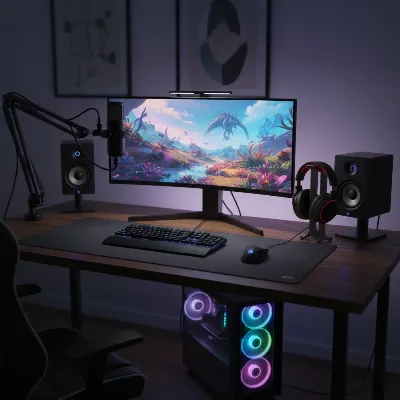 A gamer at a desk with two studio monitors flanking a gaming monitor, headphones on a stand, and a microphone, showcasing a professional audio setup for gaming.
Authentic Audio Reproduction
|
Our Picks for the Best Studio Monitor in 2026
As an Amazon Associate I earn from qualifying purchases.
|
||
| Num | Product | Action |
|---|---|---|
| 1 | PreSonus Eris 3.5 Studio Monitors, Pair — Powered, Active Monitor Speakers for Near Field Music Production, Desktop Computer, Hi-Fi Audio |

|
| 2 | Edifier R1280T Powered Bookshelf Speakers - 2.0 Active Near Field Studio Monitor Speaker - Wooden Enclosure - 42 Watts RMS Power |
|
| 3 | Yamaha HS4 Powered Studio Monitor in White, Pair (HS4 W) |
|
| 4 | Yamaha HS3 Powered Studio Monitor in Black, Pair (HS3 B) |
|
| 5 | Mackie CR3.5 3.5" Creative Reference Powered Studio Monitors with Tone Knob and Location Switch — Active Speakers for Music Production, Desktop Computer, Gaming, HiFi Listening |
|
| 6 | PreSonus Eris E4.5-2-Way 4.5" Near Field Studio Monitor (Pair) |
|
| 7 | PreSonus Eris 3.5 Studio Monitors (White), Pair — 3.5" Inch Powered Bookshelf Speakers, Stereo, Desktop Computer, Near Field Music Production, Audio Mixing Recording |
|
| 8 | PreSonus Eris E5 2-Way 5.25" Near Field Studio Monitor |
|
| 9 | Edifier MR4 Powered Studio Monitor Speakers, 4" Active Near-Field Monitor Speaker - White (Pair) |
|
| 10 | (2) JBL 305P MkII 5" 2-Way Active Powered Studio Reference Monitors Speakers |
|
Unlike many “gaming speakers” that often feature a “smiley face” EQ curve (boosted bass and treble) designed for a more impactful but less accurate sound, studio monitors deliver audio as the game developers intended. This means you experience the game’s sound design in its truest form, from the delicate musical scores to the explosive sound effects, without any artificial coloring. For those who appreciate audio fidelity, this authenticity is invaluable.
Robust Build Quality
Built for the demanding environment of a professional studio, studio monitors are generally constructed with higher-quality components and more robust materials than typical consumer-grade speakers. This often translates to greater durability and longevity, making them a sound long-term investment for your audio needs. Their professional heritage ensures they are designed to perform consistently over extended periods.
The Reality Check: Cons of Using Studio Monitors for Gaming
While the pros are compelling, using studio monitors for gaming isn’t without its drawbacks. It’s essential to consider these potential downsides to determine if they align with your personal preferences and setup.
Less “Fun” Sound Profile
The very neutrality that makes studio monitors excellent for audio production can sometimes be perceived as a lack of “fun” for casual gaming. If you’re accustomed to speakers that exaggerate bass for impactful explosions and heightened immersion, the flat response of studio monitors might initially sound less exciting. For gamers who crave that extra rumble, a dedicated subwoofer might be a necessary addition to complement smaller monitors.
Complex Setup Requirements
Integrating studio monitors into a gaming setup can be more involved than simply plugging in a standard pair of PC speakers. Many studio monitors, especially active ones, require balanced audio inputs (XLR or TRS) to minimize noise and interference. This often necessitates an external audio interface or DAC (Digital-to-Analog Converter) to convert your PC’s digital audio signal into a high-quality analog signal that the monitors can accept. This adds to both the cost and complexity of the setup.
Potential Latency Issues
While wired studio monitors generally boast very low latency, some modern studio monitors incorporate Digital Signal Processing (DSP) for room correction or sound shaping. This DSP can introduce a small amount of latency, typically a few milliseconds, but in some advanced systems, it could be higher. For competitive gamers where every millisecond counts, even a small delay can be noticeable. Wireless studio monitors, while convenient, are generally not recommended for critical gaming due to inherent latency in wireless transmission.
Lack of Integrated Microphone
Studio monitors are, by design, solely output devices. Unlike gaming headsets, they do not come with an integrated microphone. If you play multiplayer games that require voice communication, you’ll need to invest in a separate microphone solution, such as a standalone USB microphone or a professional XLR microphone paired with an audio interface. This adds another component and cost to your setup.
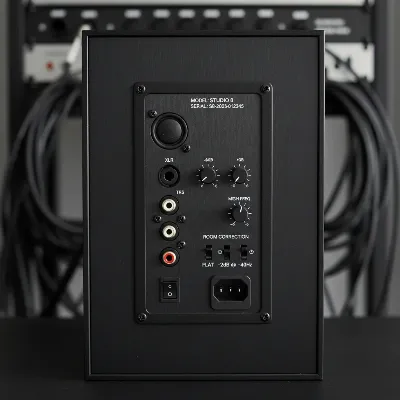 A close-up shot of the back of an active studio monitor with various input ports, highlighting the complexity of connectivity.
Sensitivity to Room Acoustics
Studio monitors are designed to perform optimally in acoustically treated environments. In an untreated room with reflective surfaces, the accurate sound they produce can be muddled by echoes and standing waves, especially in the bass frequencies. This means that without some form of room treatment (acoustic panels, bass traps), you might not fully experience the benefits of your expensive monitors, potentially negating their accuracy.
Cost & Availability
High-quality studio monitors, particularly those from renowned brands, can represent a significant investment. Many studio monitors are sold individually (per speaker) rather than in pairs, which can sometimes catch buyers off guard. While there are excellent budget-friendly options, achieving true “studio quality” often comes with a higher price tag than typical gaming speaker systems.
Key Considerations When Using Studio Monitors for Gaming
If you’re still considering studio monitors for your gaming setup, here are crucial factors to weigh to ensure you make the best choice for your needs.
Frequency Response: Accuracy vs. Tailored Sound
Your preference for frequency response is subjective. A flat frequency response is ideal for competitive gaming, allowing you to hear subtle details and positional audio clearly. However, if you primarily play immersive, single-player games and prefer a more impactful, “fun” sound with boosted bass for cinematic moments, you might miss the exaggerated low-end of consumer speakers. Some monitors offer EQ adjustments, but they still adhere to a more neutral base.
Soundstage & Imaging: The Competitive Advantage
The ability of studio monitors to create a wide soundstage and precise imaging is a huge asset for competitive gaming. It allows you to accurately perceive the direction and distance of in-game sounds like footsteps, gunfire, or environmental cues. Look for monitors known for their excellent stereo separation and transient response to maximize this benefit.
Audio Latency: The Critical Factor for Competitive Play
For competitive gamers, minimizing audio latency is paramount. While the latency introduced by some modern studio monitors with DSP is usually minimal (around 3ms and often imperceptible), it’s worth researching specific models if you play fast-paced, reaction-based games. Always prioritize wired connections over wireless for the lowest possible latency in your audio chain, from your PC to your monitors.
Connectivity: Importance of Balanced Cables and Audio Interfaces
Most studio monitors utilize balanced XLR or 1/4-inch TRS inputs to prevent noise and interference, especially in setups with powerful graphics cards that can introduce ground loops. This means you’ll likely need an audio interface with balanced outputs to connect your monitors to your PC properly. While some monitors have RCA or 3.5mm inputs, balanced connections are superior for maintaining signal integrity.
Woofer Size & Bass Extension: Impact on Low-End
The woofer size of a studio monitor directly impacts its bass extension. Smaller monitors (e.g., 3-inch or 4-inch woofers) may struggle to reproduce very deep bass frequencies with the same impact as larger speakers or a dedicated subwoofer. For a full-range gaming experience, especially if you enjoy games with rich soundscapes and explosions, a 5-inch or 8-inch woofer, or the addition of a subwoofer, might be more suitable. Consider your room size and how much bass you truly need.
Active vs. Passive: Simplified Setup of Active Monitors
Modern studio monitors are predominantly active, meaning they have built-in amplifiers matched precisely to their drivers. This simplifies setup considerably as you don’t need to purchase a separate amplifier. Passive monitors require an external amplifier, adding to complexity and cost, though they offer more flexibility for audiophiles who prefer to mix and match components. For gaming, active monitors are generally the more convenient and recommended choice.
Room Acoustics: The Silent Partner in Great Sound
The performance of any speaker, including studio monitors, is heavily influenced by the acoustics of the listening environment. Highly reflective surfaces (bare walls, glass) can cause sound reflections that degrade accuracy and imaging. While professional room treatment can be costly, even simple measures like placing acoustic foam panels, bass traps, or strategic furniture placement can significantly improve the sound quality you get from your monitors.
Top Studio Monitor Recommendations for Gamers
While the “best” monitor is subjective, here’s a comparison of some highly-regarded studio monitors that gamers often consider, balancing accuracy with practicality.
| Model | Woofer Size | Key Gaming Feature | Pros | Cons | Price Range (Pair) |
|---|---|---|---|---|---|
| JBL 305P MkII | 5-inch | Excellent imaging, detailed sound | Wide sweet spot, neutral, good bass for size | Can sound bright to some, minor port noise at high volumes | Mid-range |
| PreSonus Eris E4.5 | 4.5-inch | Compact, front-ported, room EQs | Affordable, good clarity, acoustic tuning options | Limited bass extension, less powerful than larger options | Budget-friendly |
| KRK Rokit 5 G4 | 5-inch | Dynamic, powerful bass, DSP EQs | Punchy low-end, customizable sound, good for immersive games | Can be bass-heavy for critical listening, distinctive yellow cones | Mid-range |
| Yamaha HS5 | |||||
| Focal Alpha 50 Evo | 5-inch | Detailed highs, wide dispersion | Excellent detail and soundstage, natural sound | Mid-range bass can be subtle, not as “punchy” as some rivals | Mid-range |
| Adam Audio T5V | 5-inch | Ribbon tweeter for detailed highs | Exceptional clarity, airy highs, wide sweet spot | Can sound analytical, bass requires good room acoustics | Higher Mid-range |
Note: Prices are approximate and can vary by region and retailer. Many studio monitors are sold individually, so to factor in the cost for a pair.
Alternatives to Studio Monitors for Your Gaming Setup
While studio monitors offer a unique set of advantages, they aren’t the only option for superior gaming audio. Here are a few popular alternatives, each with its own strengths and weaknesses.
Gaming Headsets
Gaming headsets are arguably the most common choice for gamers, and for good reason. They typically feature integrated microphones for communication, are designed for comfort during long sessions, and often include virtual surround sound features. While convenient, many gaming headsets sacrifice pure audio fidelity for features, often having a “V-shaped” sound signature with boosted bass and treble that can muddy details.
Hi-Fi Speakers
High-fidelity (Hi-Fi) speakers are designed for enjoyable music listening, often with a warmer or more colored sound profile than studio monitors. They can offer a more “fun” and immersive experience for casual gaming, often with robust bass. However, they may lack the pinpoint accuracy and flat frequency response crucial for competitive play, and their setup can be as complex as passive studio monitors, requiring a separate amplifier.
Soundbars
Soundbars offer a compact, space-saving solution, providing a significant upgrade over built-in monitor speakers. They are convenient and can create a broader soundstage than a single speaker. However, they are generally the least accurate audio solution, with limited stereo separation and sound imaging, making them less suitable for discerning gamers who prioritize competitive performance or true audio fidelity.
Setting Up Your Studio Monitors for Optimal Gaming
Proper setup is critical to extracting the best performance from your studio monitors, transforming your gaming experience from good to exceptional.
Placement & “Sweet Spot”
The “equilateral triangle” principle is key. Your two monitors and your head should form an equilateral triangle. Place the tweeters (the smaller drivers for high frequencies) at ear level. This ensures you’re directly in the “sweet spot” where the sound is most balanced and accurate. Avoid placing monitors flush against walls or in corners, as this can exaggerate bass frequencies and muddy the sound. Use monitor stands or isolation pads to decouple them from your desk, reducing unwanted vibrations.
Cable Management & Interference
Given the sensitivity of studio monitors, proper cabling is essential. Use balanced XLR or TRS cables to connect your audio interface to your monitors. These cables are designed to reject interference, preventing unwanted hums or static that can arise from powerful PC components like graphics cards. Keep cables tidy and away from power sources where possible.
Room Treatment Basics
Even basic acoustic treatment can make a substantial difference. Placing acoustic panels at primary reflection points (where sound bounces from your monitors to your ears) can help control echoes. Bass traps in corners can tame unruly low frequencies. Even heavy curtains and a rug can absorb sound and improve the overall clarity of your gaming audio. You don’t need a professional studio, but mindful consideration of your room’s acoustics is beneficial.
Calibration (Optional but Recommended)
For the most precise audio, consider calibration. Tools like reference microphones and room correction software can analyze your room’s acoustic profile and automatically apply EQ adjustments to your monitors, aiming for the flattest possible frequency response at your listening position. This ensures your monitors are performing optimally in your unique gaming space.
Conclusion
So, can you use studio monitors for gaming? Absolutely. For the discerning gamer who values pristine audio accuracy, a wide soundstage, and the ability to discern every subtle in-game detail, studio monitors offer an unparalleled experience. They can provide a significant competitive edge and a deeply authentic auditory journey, free from artificial enhancements. However, this comes with trade-offs, including a potentially less “fun” sound profile for casual play, more complex setup requirements, and the need for a separate microphone.
The choice depends on your priorities. Are you seeking the absolute truth in gaming audio, even if it means a more involved setup, or do you prefer the convenience and consumer-friendly sound of traditional gaming solutions? With the right monitors and a thoughtful setup, your virtual worlds can come alive with a clarity and precision you’ve never experienced before. What kind of gaming audio experience are you truly striving for?
Frequently Asked Questions
Do I need an audio interface for studio monitors with gaming?
Yes, generally an audio interface is recommended. It provides high-quality digital-to-analog conversion, a powerful headphone amplifier, and balanced outputs (XLR or TRS) for connecting to studio monitors, minimizing noise and maximizing sound fidelity from your PC.
Are studio monitors good for competitive FPS gaming?
Studio monitors are excellent for competitive FPS gaming due to their flat frequency response, superior soundstage, and precise imaging. This allows players to accurately pinpoint enemy locations, hear subtle footsteps, and react faster based on precise audio cues, offering a clear advantage.
What size studio monitor is best for gaming?
For most desktop gaming setups, 5-inch or 6.5-inch studio monitors are ideal. They offer a good balance of frequency response and bass extension without overwhelming smaller rooms. Smaller monitors (3-4 inch) might lack bass, while larger ones (8-inch+) can be excessive for close-range listening.
Can I connect studio monitors directly to my PC?
While some studio monitors have RCA or 3.5mm inputs allowing direct connection to a PC’s onboard sound card, this is generally not recommended. A dedicated audio interface or DAC is preferred to ensure optimal sound quality, proper gain staging, and to utilize balanced connections for noise reduction.
Do studio monitors have surround sound?
No, studio monitors are designed for stereo (2.0) sound reproduction, focusing on accuracy and precise imaging within a stereo field. They do not natively offer multi-channel surround sound like 5.1 or 7.1 systems. However, some games or software can create virtual surround sound that can be experienced through stereo monitors.
Frequently Asked Questions
Do I need an audio interface for studio monitors with gaming?
Yes, an audio interface is generally recommended for studio monitors used with gaming. It provides high-quality digital-to-analog conversion and balanced outputs (XLR or TRS), which are crucial for minimizing noise and maximizing sound fidelity from your PC. This setup ensures optimal performance for your monitors.
Are studio monitors good for competitive FPS gaming?
Studio monitors are excellent for competitive FPS gaming due to their flat frequency response, superior soundstage, and precise imaging. This allows players to accurately pinpoint enemy locations and hear subtle footsteps, offering a clear advantage in fast-paced games. The uncolored sound helps in reacting faster based on precise audio cues.
What size studio monitor is best for gaming?
For most desktop gaming setups, 5-inch or 6.5-inch studio monitors are ideal. These sizes offer a good balance of frequency response and bass extension without overwhelming smaller rooms. Smaller monitors (3-4 inch) might lack sufficient bass, while larger ones (8-inch+) can be excessive for close-range listening environments.
Can I connect studio monitors directly to my PC?
While some studio monitors have RCA or 3.5mm inputs that allow direct connection to a PC's onboard sound card, this is generally not recommended for optimal performance. A dedicated audio interface or DAC is preferred to ensure superior sound quality, proper gain staging, and to utilize balanced connections for noise reduction, which is vital for studio-grade audio.
Do studio monitors have surround sound capabilities?
No, studio monitors are designed for stereo (2.0) sound reproduction, focusing on accuracy and precise imaging within a stereo field. They do not natively offer multi-channel surround sound like 5.1 or 7.1 systems. However, some games or software can create virtual surround sound that can be experienced effectively through high-quality stereo monitors.

I was skeptical about using studio monitors for gaming, but after reading about the flat, neutral frequency response, I decided to try the KRK Rokit 5 G4s. The difference is night and day! I can hear footsteps in Warzone so much clearer now, it’s almost like cheating. The soundstage is incredible, really helps with pinpointing enemy locations.
I’ve been using consumer speakers for years and always felt like I was missing something. The explanation about how studio monitors reproduce sounds exactly as game developers intended really resonated with me. I picked up a pair of JBL 305P MkIIs and they’re fantastic for my setup. My only minor gripe is they’re a bit larger than I expected for my small desk, but the audio quality makes up for it.
I got the PreSonus Eris E3.5 based on the recommendation for a budget-friendly option. While the audio accuracy is definitely better than my old PC speakers, I found the bass to be a little lacking for certain explosion-heavy games. It’s not bad, but I was hoping for a bit more punch. Still, for hearing subtle in-game cues, they do a decent job.
The competitive advantage aspect really sold me on trying studio monitors for gaming. I went with the Yamaha HS5s and I’m blown away by the detail. I’m hearing things in my favorite RPGs that I never noticed before. It’s like rediscovering all my games with a whole new level of immersion. Definitely worth the investment for serious gamers.