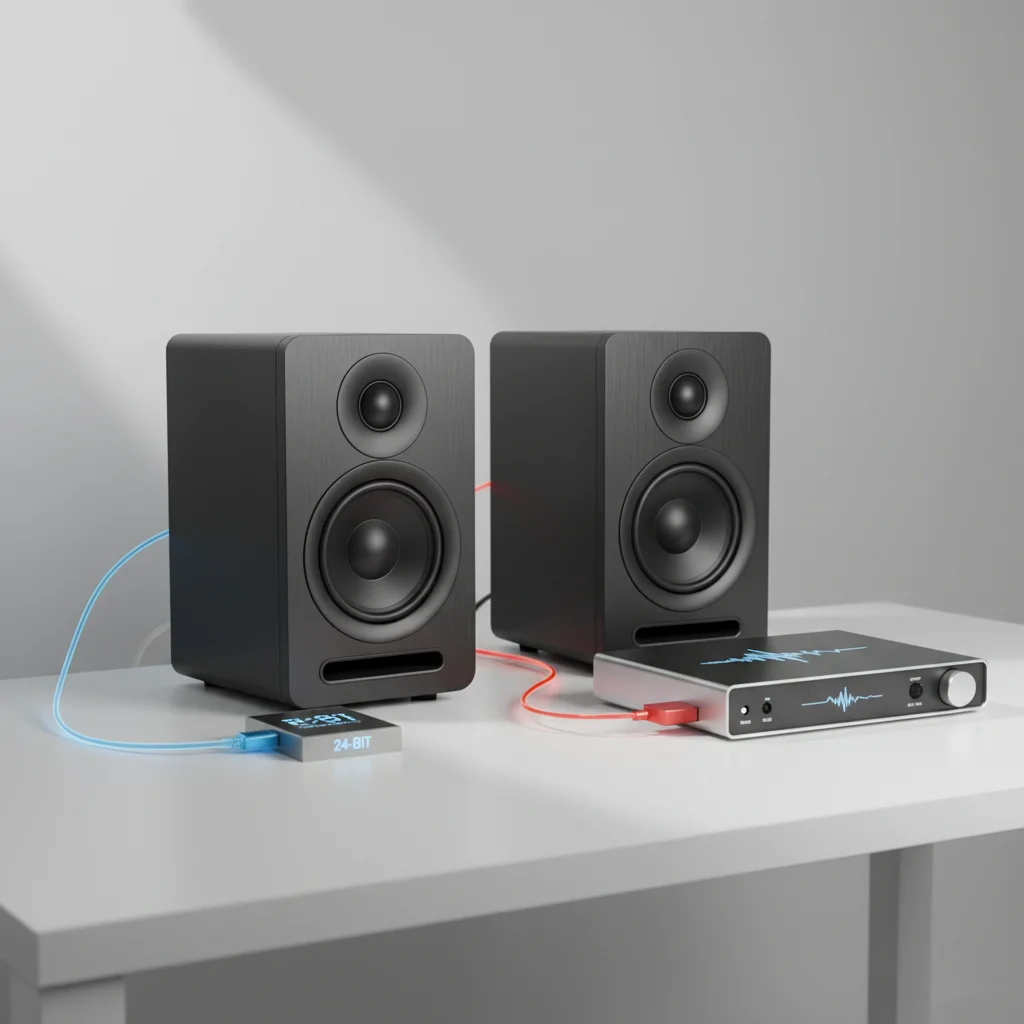
Studio monitor bit depth directly impacts the dynamic range and fidelity of your audio. While it doesn’t change the physical sound waves produced by the monitors themselves, it dictates the precision with which your digital audio signal is represented. A higher bit depth, such as 24-bit, offers a significantly wider dynamic range and a lower noise floor compared to 16-bit, leading to a more accurate and detailed listening experience.
Understanding Bit Depth in Digital Audio
Bit depth refers to the number of bits used to represent the amplitude of an audio sample. Think of it like a ruler: a higher bit depth means more markings on the ruler, allowing for finer measurements of the sound wave’s intensity. For every additional bit, the dynamic range doubles. This means 16-bit audio offers 65,536 possible amplitude levels, while 24-bit audio provides 16,777,216 levels. This increased resolution is crucial for capturing the subtle nuances and dynamic shifts in music production.
The primary benefit of a higher bit depth is the reduction of quantization error, which is a form of distortion introduced when an analog signal is converted to digital. With more bits, the digital representation more closely matches the original analog waveform, resulting in a cleaner and more transparent sound. This is particularly important during the recording and mixing stages, where every detail matters.
Impact on Dynamic Range and Noise Floor
The dynamic range of an audio system is the difference between the loudest and quietest sounds it can reproduce. For 16-bit audio, the theoretical dynamic range is approximately 96 dB, while 24-bit audio boasts a theoretical dynamic range of 144 dB. This extra headroom in 24-bit allows engineers to record and mix at lower levels without fear of introducing noise, preserving the integrity of the quietest passages and preventing clipping on the loudest peaks.
A lower noise floor is another significant advantage of higher bit depths. The noise floor is the level of inherent electrical noise in an audio system. With 24-bit, the quantization noise is pushed far below the audible threshold, making it virtually imperceptible. This translates to a cleaner signal, especially when working with quiet instruments or delicate vocal performances, where even subtle background noise can be detrimental to the final mix.
When Does Bit Depth Matter Most?
|
Our Picks for the Best Studio Monitor in 2026
As an Amazon Associate I earn from qualifying purchases.
|
||
| Num | Product | Action |
|---|---|---|
| 1 | PreSonus Eris E5 2-Way 5.25" Near Field Studio Monitor |

|
| 2 | Mackie CR3.5 3.5" Creative Reference Powered Studio Monitors with Tone Knob and Location Switch — Active Speakers for Music Production, Desktop Computer, Gaming, HiFi Listening |
|
| 3 | Yamaha HS3 Powered Studio Monitor in Black, Pair (HS3 B) |
|
| 4 | Edifier MR4 Powered Studio Monitor Speakers, 4" Active Near-Field Monitor Speaker - White (Pair) |
|
| 5 | PreSonus Eris 3.5 Studio Monitors, Pair — Powered, Active Monitor Speakers for Near Field Music Production, Desktop Computer, Hi-Fi Audio |
|
| 6 | PreSonus Eris 3.5 Studio Monitors (White), Pair — 3.5" Inch Powered Bookshelf Speakers, Stereo, Desktop Computer, Near Field Music Production, Audio Mixing Recording |
|
| 7 | PreSonus Eris E4.5-2-Way 4.5" Near Field Studio Monitor (Pair) |
|
| 8 | (2) JBL 305P MkII 5" 2-Way Active Powered Studio Reference Monitors Speakers |
|
| 9 | Yamaha HS4 Powered Studio Monitor in White, Pair (HS4 W) |
|
| 10 | Edifier R1280T Powered Bookshelf Speakers - 2.0 Active Near Field Studio Monitor Speaker - Wooden Enclosure - 42 Watts RMS Power |
|
Bit depth matters most during the initial recording and mixing phases of audio production. When you’re capturing raw audio, using a higher bit depth (typically 24-bit) ensures that you’re recording with the maximum possible fidelity and dynamic range. This gives you more flexibility during post-production, allowing for more aggressive processing without introducing audible artifacts.
For playback, especially with consumer-grade equipment, the difference between 16-bit and 24-bit might be less noticeable to the average listener. However, in a critical listening environment with high-quality studio monitors, the enhanced detail and reduced noise floor of 24-bit audio become apparent. It allows for a more accurate representation of the mix, helping engineers make better decisions.
Choosing the Right Bit Depth for Your Workflow
For professional audio production, 24-bit is the industry standard and highly recommended. It provides the necessary headroom and resolution for high-quality recordings, mixing, and mastering. While 32-bit float is also available in some DAWs, it’s primarily used internally for processing and doesn’t offer a direct audible advantage over 24-bit for recording or final output.
- Record all tracks at 24-bit to maximize dynamic range.
- Mix and process your audio within a 24-bit or 32-bit float environment.
- When exporting for distribution, consider the target platform (e.g., 16-bit for CD, 24-bit for high-resolution streaming).
- Ensure your audio interface and DAW support your chosen bit depth.
Ultimately, while your studio monitors reproduce the sound, the quality of the digital signal they receive is paramount. Optimizing your bit depth is a fundamental step in achieving professional-grade audio.Investing in an audio interface that supports 24-bit recording and playback is a crucial upgrade for any serious home studio.This ensures that the pristine digital signal is accurately converted to analog for your monitors.
