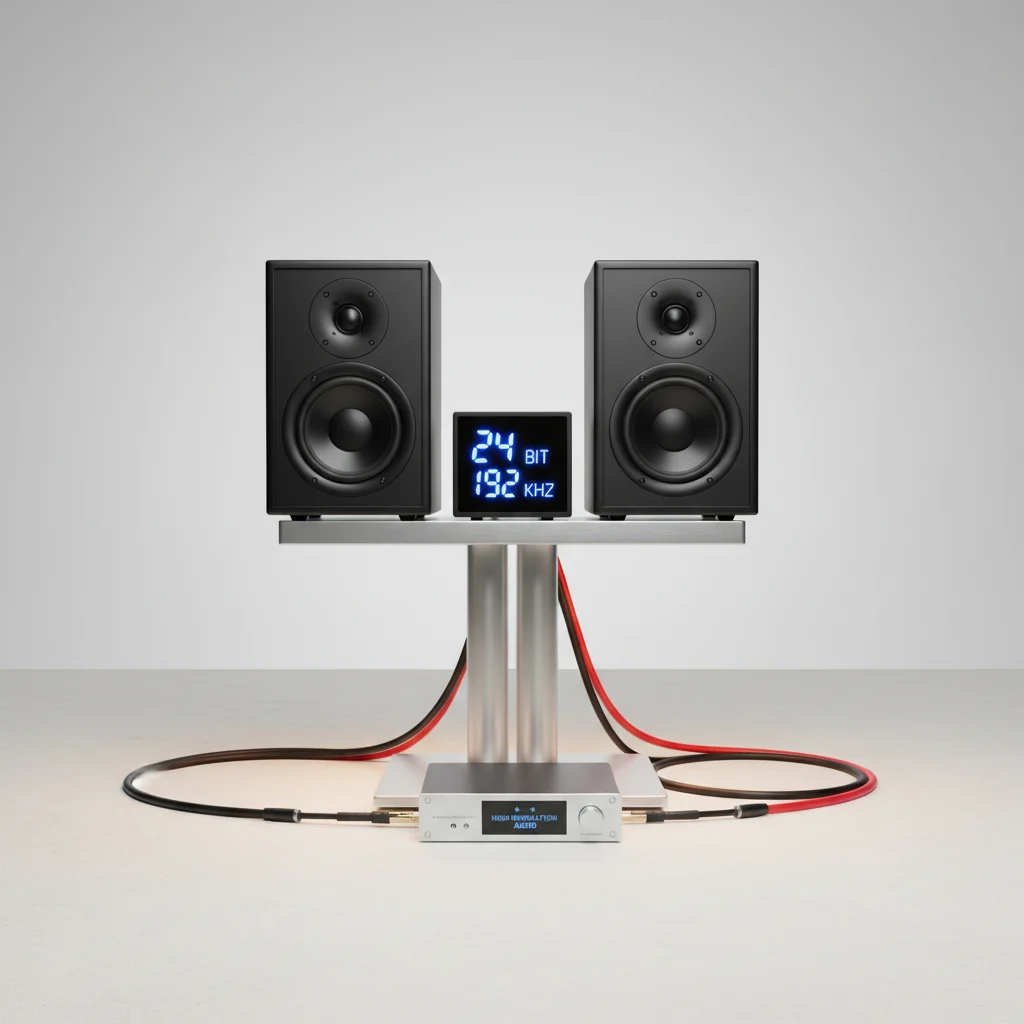
Studio monitor bit rate significantly affects sound quality, primarily by determining the dynamic range and resolution of your audio. A higher bit rate, such as 24-bit, provides a much wider dynamic range and finer detail compared to lower bit rates like 16-bit, which is crucial for professional audio production and critical listening.
Understanding Bit Rate in Audio
Bit rate, often expressed as bits per sample, refers to the amount of digital information used to represent each sample of an audio signal. In simpler terms, it dictates how precisely the amplitude of a sound wave is captured. A higher bit rate means more steps are available to describe the signal’s amplitude, leading to a more accurate and nuanced representation of the original analog sound. This increased precision helps to reduce quantization error, which is a form of distortion inherent in digital audio conversion. For expert studio monitor reviews on this site.
16-bit vs. 24-bit Audio: The Key Differences
The most common bit rates encountered in studio monitoring are 16-bit and 24-bit. 16-bit audio offers a theoretical dynamic range of approximately 96 dB, which is sufficient for many consumer applications like CDs. However, 24-bit audio expands this to a theoretical 144 dB. This extra dynamic range is vital in a studio environment, allowing engineers to capture and mix audio with greater headroom and less risk of clipping or introducing noise during processing. It also means quieter details are preserved more effectively, leading to a richer and more immersive listening experience.
Impact on Recording and Mixing
|
Our Picks for the Best Studio Monitor in 2026
As an Amazon Associate I earn from qualifying purchases.
|
||
| Num | Product | Action |
|---|---|---|
| 1 | (2) JBL 305P MkII 5" 2-Way Active Powered Studio Reference Monitors Speakers |

|
| 2 | Mackie CR3.5 3.5" Creative Reference Powered Studio Monitors with Tone Knob and Location Switch — Active Speakers for Music Production, Desktop Computer, Gaming, HiFi Listening |
|
| 3 | Yamaha HS3 Powered Studio Monitor in Black, Pair (HS3 B) |
|
| 4 | PreSonus Eris 3.5 Studio Monitors (White), Pair — 3.5" Inch Powered Bookshelf Speakers, Stereo, Desktop Computer, Near Field Music Production, Audio Mixing Recording |
|
| 5 | PreSonus Eris E4.5-2-Way 4.5" Near Field Studio Monitor (Pair) |
|
| 6 | Yamaha HS4 Powered Studio Monitor in White, Pair (HS4 W) |
|
| 7 | PreSonus Eris E5 2-Way 5.25" Near Field Studio Monitor |
|
| 8 | PreSonus Eris 3.5 Studio Monitors, Pair — Powered, Active Monitor Speakers for Near Field Music Production, Desktop Computer, Hi-Fi Audio |
|
| 9 | Edifier MR4 Powered Studio Monitor Speakers, 4" Active Near-Field Monitor Speaker - White (Pair) |
|
| 10 | Edifier R1280T Powered Bookshelf Speakers - 2.0 Active Near Field Studio Monitor Speaker - Wooden Enclosure - 42 Watts RMS Power |
|
When recording, using a higher bit rate like 24-bit provides significantly more flexibility. It allows you to record at lower input levels to avoid accidental clipping, knowing that the extra bits will still capture sufficient detail. This ‘safety net’ is invaluable during tracking sessions. In mixing, the increased resolution of 24-bit audio means that subtle effects, reverbs, and compression settings can be applied with greater transparency and less degradation of the original signal. This translates to mixes that sound more open, detailed, and professional.
Perceivable Differences for the Listener
While some argue that the human ear cannot discern the difference between 16-bit and 24-bit audio, especially in casual listening environments, the difference becomes apparent on high-quality studio monitors in a treated room. The extended dynamic range and reduced noise floor of 24-bit audio contribute to a sense of depth, clarity, and realism that 16-bit often struggles to achieve. This is particularly true for complex arrangements or tracks with very quiet passages. For critical listening and mastering, 24-bit is the undisputed standard.
Factors Beyond Bit Rate
While bit rate is crucial, it’s just one component of overall sound quality. Other factors play equally important roles:
- Sample Rate: Determines the frequency range captured.
- Monitor Quality: High-quality monitors reveal more detail.
- Room Acoustics: A treated room minimizes reflections and standing waves.
- Digital-to-Analog Converters (DACs): The quality of your DAC impacts conversion accuracy.
- Cabling: Proper cabling minimizes interference and signal loss.
Conclusion
In summary, studio monitor bit rate has a direct and significant impact on sound quality. Opting for 24-bit audio over 16-bit provides a superior dynamic range and resolution, which is essential for accurate recording, mixing, and critical listening in a professional or home studio setting. While other factors contribute to the overall audio experience, a higher bit rate lays the fundamental groundwork for capturing and reproducing high-fidelity sound.

I’ve been using 16-bit for ages because I thought it was ‘good enough’ for my portable setup. This really opened my eyes to how much detail I was losing. My mixes sound much clearer and less ‘flat’ now that I’m paying attention to the bit rate. I’m still getting used to the difference, but it’s a definite improvement.
This explained quantization error so clearly! I’ve been struggling with some subtle distortion in my recordings and couldn’t pinpoint why. Understanding how bit rate affects the precision of the signal has been a game-changer. My tracks are sounding much cleaner now, especially after making sure my entire signal chain supports a higher bit rate.
While I agree that higher bit rates like 24-bit offer better resolution, I didn’t find the difference as dramatic as some claim for my specific setup. Maybe it’s my older monitors, but the ‘finer detail’ wasn’t a huge leap for me. It’s good to know the technical reasons, but for casual listening or basic demos, 16-bit still holds up pretty well.
I always wondered if upgrading my interface would make a difference, and after reading about 24-bit bit rates, I finally pulled the trigger. The dynamic range on my mixes is noticeably better now. It’s like I can hear all the subtle nuances I was missing before, especially in the quieter parts of a track. Definitely worth the investment for anyone serious about their home studio.