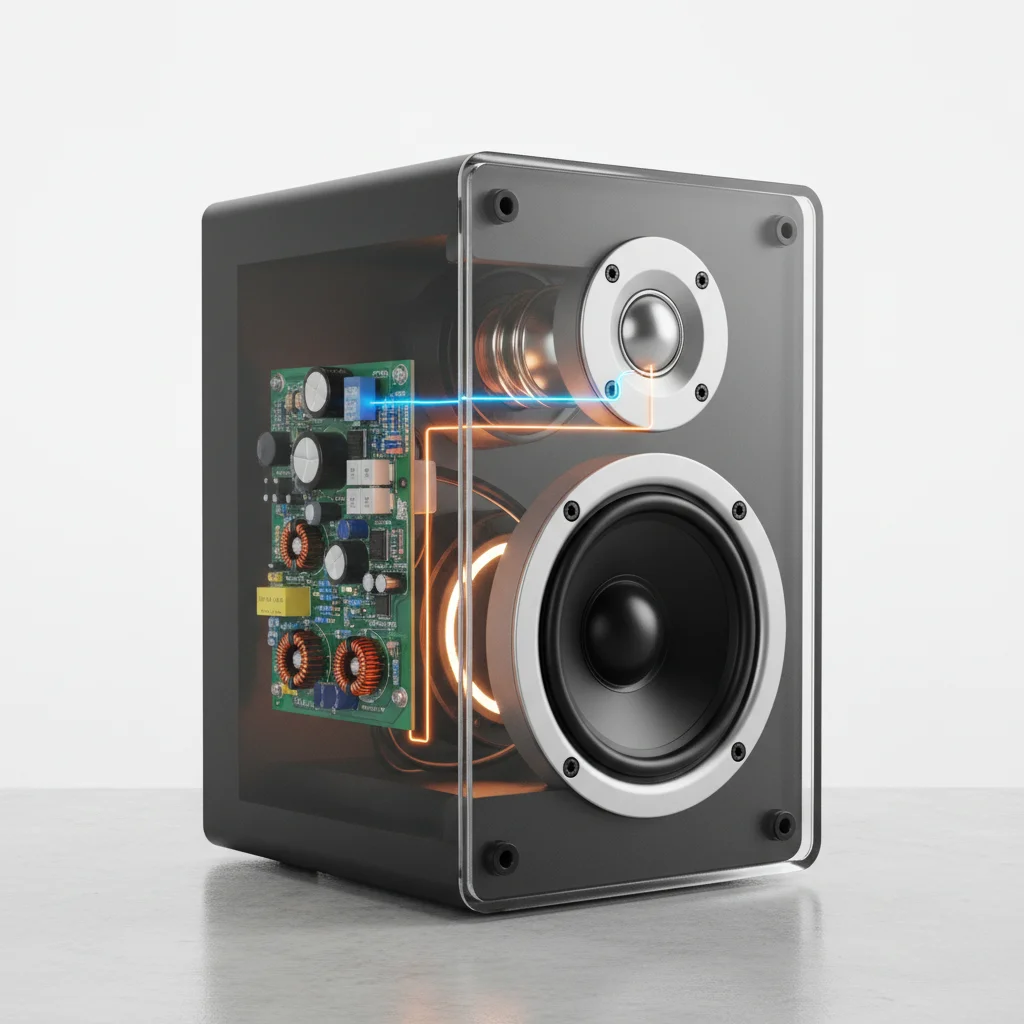
A studio monitor crossover significantly affects sound quality by directing specific frequency ranges to the appropriate drivers, ensuring each speaker component reproduces its intended sound without interference. This precise frequency division prevents distortion and improves clarity, making it a critical element in achieving accurate audio reproduction in studio environments.
What is a Studio Monitor Crossover?
A studio monitor crossover is an electronic filter network that divides an audio signal into different frequency bands, sending each band to the specific speaker driver designed to reproduce it. For instance, in a two-way monitor, the crossover sends low frequencies to the woofer and high frequencies to the tweeter. This prevents drivers from attempting to reproduce frequencies outside their optimal range, which would lead to distortion and reduced fidelity. There are typically two main types: passive and active crossovers. For shop curated studio monitor on this site.
Passive vs. Active Crossovers: Key Differences
Passive crossovers are found in passive studio monitors and are placed between the amplifier and the speaker drivers. They use components like capacitors, inductors, and resistors to filter frequencies. While simpler in design, they can introduce phase shifts and power loss. Active crossovers, on the other hand, are used in active (powered) studio monitors and are placed before the amplifier stage. This allows for more precise filtering at lower signal levels, leading to greater accuracy, less distortion, and often more efficient power usage. Most professional studio monitors utilize active crossovers for their superior performance.
How Crossover Points Impact Sound
|
Our Picks for the Best Studio Monitor in 2026
As an Amazon Associate I earn from qualifying purchases.
|
||
| Num | Product | Action |
|---|---|---|
| 1 | Yamaha HS4 Powered Studio Monitor in White, Pair (HS4 W) |

|
| 2 | (2) JBL 305P MkII 5" 2-Way Active Powered Studio Reference Monitors Speakers |
|
| 3 | Edifier R1280T Powered Bookshelf Speakers - 2.0 Active Near Field Studio Monitor Speaker - Wooden Enclosure - 42 Watts RMS Power |
|
| 4 | Edifier MR4 Powered Studio Monitor Speakers, 4" Active Near-Field Monitor Speaker - White (Pair) |
|
| 5 | Yamaha HS3 Powered Studio Monitor in Black, Pair (HS3 B) |
|
| 6 | Mackie CR3.5 3.5" Creative Reference Powered Studio Monitors with Tone Knob and Location Switch — Active Speakers for Music Production, Desktop Computer, Gaming, HiFi Listening |
|
| 7 | PreSonus Eris 3.5 Studio Monitors, Pair — Powered, Active Monitor Speakers for Near Field Music Production, Desktop Computer, Hi-Fi Audio |
|
| 8 | PreSonus Eris 3.5 Studio Monitors (White), Pair — 3.5" Inch Powered Bookshelf Speakers, Stereo, Desktop Computer, Near Field Music Production, Audio Mixing Recording |
|
| 9 | PreSonus Eris E4.5-2-Way 4.5" Near Field Studio Monitor (Pair) |
|
| 10 | PreSonus Eris E5 2-Way 5.25" Near Field Studio Monitor |
|
The crossover point is the frequency at which the audio signal is divided between drivers. For example, a 2-way monitor might have a crossover point at 2 kHz, meaning frequencies below 2 kHz go to the woofer, and those above go to the tweeter. The choice of crossover point is crucial and is determined by the design and characteristics of the individual drivers. An improperly chosen crossover point can lead to dips or peaks in the frequency response, causing an unnatural or inaccurate sound. Manufacturers carefully select these points to ensure a smooth transition and flat frequency response across the entire audible spectrum.
Benefits of a Well-Designed Crossover
A well-designed studio monitor crossover offers several significant benefits for audio production. These include:
- Improved clarity and detail in the soundstage.
- Reduced intermodulation distortion between drivers.
- More accurate frequency response across the entire spectrum.
- Enhanced power handling and driver protection.
- Better stereo imaging and transient response.
These advantages contribute directly to a more reliable and accurate listening experience, which is essential for making critical mixing and mastering decisions.
Troubleshooting Crossover-Related Issues
While crossovers are designed for optimal performance, issues can sometimes arise. If you notice a sudden drop in specific frequency ranges, muffled sound, or distortion that wasn’t present before, it could indicate a crossover problem. In passive monitors, component failure (like a blown capacitor) is possible. In active monitors, issues are often related to the digital signal processing (DSP) or internal amplifier components. Always consult the manufacturer’s guide or a qualified technician for repairs, as tampering with internal electronics can cause further damage or void warranties.
Conclusion
The studio monitor crossover is an indispensable component that dictates how effectively your monitors reproduce sound. By accurately dividing frequencies and directing them to the correct drivers, it ensures clarity, reduces distortion, and contributes significantly to the overall accuracy of your monitoring system. Understanding its function helps appreciate the engineering behind high-quality studio monitors and why a well-implemented crossover is vital for critical listening and professional audio production.
Frequently Asked Questions
What is the primary function of a studio monitor crossover?
The primary function of a studio monitor crossover is to divide an audio signal into different frequency bands, sending each band to the specific speaker driver designed to reproduce it. This ensures that woofers handle low frequencies and tweeters handle high frequencies, preventing distortion.
What are the main differences between passive and active crossovers?
Passive crossovers are placed between the amplifier and speaker drivers in passive monitors, using components like capacitors and inductors. Active crossovers are used in active monitors before the amplifier stage, allowing for more precise filtering and greater accuracy at lower signal levels.
How does the crossover point influence the sound of studio monitors?
The crossover point is the frequency where the audio signal is divided between drivers, such as 2 kHz for a 2-way monitor. An improperly chosen crossover point can lead to dips or peaks in the frequency response, resulting in an unnatural or inaccurate sound.
What are the key benefits of a well-designed crossover system?
A well-designed crossover system offers several benefits, including improved clarity, reduced intermodulation distortion, more accurate frequency response, enhanced power handling, and better stereo imaging. These advantages are crucial for reliable audio production decisions.
What are common signs of crossover-related issues in studio monitors?
Common signs of crossover-related issues include a sudden drop in specific frequency ranges, muffled sound, or distortion that was not previously present. In passive monitors, this could indicate component failure, while in active monitors, it might relate to DSP or internal amplifier problems.

I’ve been using a two-way monitor setup for a while, and I never really thought about the crossover’s role beyond just splitting the signal. It’s true that preventing drivers from reproducing frequencies outside their optimal range is key. My mixes have definitely improved since I started paying more attention to the specs on the crossover. Good stuff.
This really helped me understand why my new studio monitors sound so much better than my old ones. The explanation of how the crossover directs specific frequency ranges to the appropriate drivers makes perfect sense. My mixes are tighter, and I can hear details I was missing before. It’s definitely a critical element for accurate audio reproduction.
While I agree that a good crossover prevents distortion, I found that even with a decent one, my woofer still struggles a bit with some mid-range frequencies. It’s not terrible, but I was hoping for a bit more clarity in that specific band. Maybe I need to look into a three-way system next time to really get that precise frequency division.
I always wondered why some monitors sounded muddy, and this really clarified how important the crossover is. My old setup had terrible frequency division, and now I understand why. Upgrading to monitors with a well-designed electronic filter network made a huge difference in my mixes. Everything sounds so much cleaner and more defined.