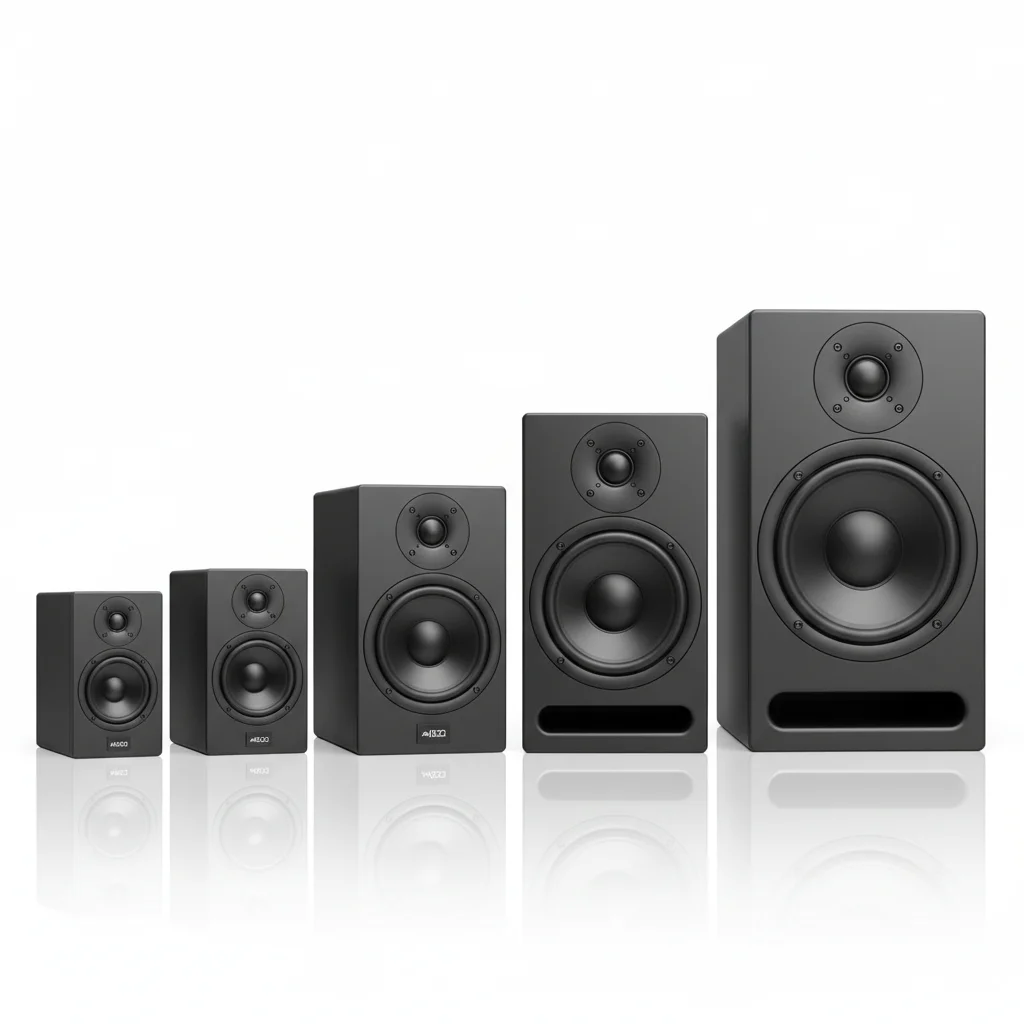
For most home studios and small to medium-sized rooms (under 150 sq ft), 5-inch to 7-inch studio monitor woofers are ideal for accurate audio reproduction. Larger monitors, while offering extended bass response, can overpower smaller rooms and lead to inaccurate mixing decisions due to room acoustics. The correct size ensures clarity and prevents issues like standing waves or distortion.
Understanding Room Size and Monitor Woofers
The size of your studio monitors should directly correlate with the dimensions of your listening environment. In a compact bedroom studio, for instance, a pair of 5-inch monitors will provide sufficient volume and bass without exciting too many room modes, which can cause muddy low-end. Conversely, in a larger, acoustically treated control room, 8-inch or even larger monitors might be necessary to achieve the desired sound pressure levels and full-range frequency response.
It’s not just about volume; it’s about clarity and accuracy. Overly large monitors in a small room can create standing waves and reflections that make it difficult to hear the true character of your mix. Conversely, undersized monitors in a large space might force you to push them too hard, leading to distortion and ear fatigue.
Nearfield vs. Midfield Monitoring
Most home and project studios utilize nearfield monitoring, where the listener is positioned relatively close to the speakers. For this setup, 5-inch to 7-inch monitors are typically recommended. Midfield monitoring, often found in larger professional studios, involves a greater listening distance and can benefit from 8-inch or larger monitors. The goal is always to create an equilateral triangle between you and your monitors, ensuring a balanced stereo image.
Factors Beyond Woofer Size
|
Our Picks for the Best Studio Monitor in 2026
As an Amazon Associate I earn from qualifying purchases.
|
||
| Num | Product | Action |
|---|---|---|
| 1 | PreSonus Eris E4.5-2-Way 4.5" Near Field Studio Monitor (Pair) |

|
| 2 | Yamaha HS4 Powered Studio Monitor in White, Pair (HS4 W) |
|
| 3 | Edifier R1280T Powered Bookshelf Speakers - 2.0 Active Near Field Studio Monitor Speaker - Wooden Enclosure - 42 Watts RMS Power |
|
| 4 | PreSonus Eris 3.5 Studio Monitors, Pair — Powered, Active Monitor Speakers for Near Field Music Production, Desktop Computer, Hi-Fi Audio |
|
| 5 | Edifier MR4 Powered Studio Monitor Speakers, 4" Active Near-Field Monitor Speaker - White (Pair) |
|
| 6 | PreSonus Eris 3.5 Studio Monitors (White), Pair — 3.5" Inch Powered Bookshelf Speakers, Stereo, Desktop Computer, Near Field Music Production, Audio Mixing Recording |
|
| 7 | PreSonus Eris E5 2-Way 5.25" Near Field Studio Monitor |
|
| 8 | Mackie CR3.5 3.5" Creative Reference Powered Studio Monitors with Tone Knob and Location Switch — Active Speakers for Music Production, Desktop Computer, Gaming, HiFi Listening |
|
| 9 | Yamaha HS3 Powered Studio Monitor in Black, Pair (HS3 B) |
|
| 10 | (2) JBL 305P MkII 5" 2-Way Active Powered Studio Reference Monitors Speakers |
|
While woofer size is a primary consideration, other factors influence your choice. The monitor’s frequency response, amplifier power, and port design (front-ported vs. rear-ported) all play a role. Front-ported designs are often more forgiving in rooms where monitors need to be placed closer to walls. Consider the overall sound profile you prefer and how it complements your musical genre.
- Consider your room’s square footage.
- Determine your typical listening distance.
- Evaluate the acoustic treatment of your space.
- Think about the genres of music you produce.
- Set a realistic budget for your monitor purchase.
When to Consider Larger Monitors
If you’re working in a professionally treated room, producing bass-heavy music (like EDM or hip-hop), or require a more expansive soundstage for critical listening, then 8-inch or even 10-inch monitors might be appropriate. However, these often come with a higher price tag and require more robust acoustic treatment to perform optimally. For most users, a well-chosen pair of 6.5-inch monitors offers an excellent balance of size, power, and accuracy.
The Impact of Subwoofers
Adding a dedicated studio subwoofer can significantly extend your system’s low-frequency response, allowing you to use smaller main monitors (e.g., 5-inch) while still achieving full-range sound. This can be an excellent solution for smaller rooms where large monitors might be impractical. When integrating a subwoofer, proper crossover settings and placement are critical to ensure a seamless transition between the subwoofer and your main monitors, avoiding a boomy or disconnected sound.
Frequently Asked Questions
What size studio monitors are best for a small home studio?
For most home studios and small to medium-sized rooms (under 150 sq ft), studio monitors with 5-inch to 7-inch woofers are generally ideal. This size provides sufficient volume and bass without exciting too many room modes, which can cause muddy low-end.
Can larger studio monitors be used in a small room?
While larger studio monitors offer extended bass response, they can overpower smaller rooms and lead to inaccurate mixing decisions due to room acoustics. Overly large monitors in a small space can create standing waves and reflections, making it difficult to hear the true character of your mix.
What is the difference between nearfield and midfield monitoring?
Nearfield monitoring involves positioning the listener relatively close to the speakers, typically recommending 5-inch to 7-inch monitors for this setup. Midfield monitoring, found in larger professional studios, involves a greater listening distance and can benefit from 8-inch or larger monitors.
How does a subwoofer impact studio monitor size choice?
Adding a dedicated studio subwoofer can significantly extend your system's low-frequency response, allowing you to use smaller main monitors (e.g., 5-inch) while still achieving full-range sound. This is an excellent solution for smaller rooms where large monitors might be impractical.
What factors besides woofer size should be considered when buying studio monitors?
Beyond woofer size, consider the monitor's frequency response, amplifier power, and port design (front-ported vs. rear-ported). Front-ported designs are often more forgiving in rooms where monitors need to be placed closer to walls, and the overall sound profile should complement your musical genre.

I was really struggling with muddy bass in my small bedroom studio, and I couldn’t figure out why my mixes sounded so off. After reading about how larger monitors can overpower smaller rooms, I switched from my old 8-inch pair to some 5-inch monitors. What a difference! The clarity is incredible now, and I can actually hear the low-end properly without it being boomy. Definitely recommend matching your monitor size to your room.
I picked up a pair of 5-inch monitors for my tiny apartment studio, hoping to avoid standing waves and distortion. While they definitely don’t overpower the room, I do find myself wishing for a bit more punch in the bass. It’s accurate, but sometimes I feel like I have to really crank them to get the full picture, which isn’t always ideal. I guess it’s a trade-off for the smaller size, but I was hoping for a little more oomph.
This really helped me understand why my mixes weren’t translating well. I have a fairly compact space, probably around 100 sq ft, and I was using 8-inch monitors. The explanation about how larger monitors can lead to inaccurate mixing decisions due to room acoustics made so much sense. Switched to a good pair of 6.5-inch monitors and my mixes are already sounding tighter and more balanced. Huge improvement!
I’ve always used 7-inch monitors in my home setup, which is about 120 sq ft. They’ve been great for general production, but I sometimes wonder if I’m missing out on some of the very lowest frequencies. The article mentioned how 5-7 inch woofers are ideal for rooms under 150 sq ft, and I agree they provide accurate audio reproduction. Maybe for my next upgrade, I’ll look into some better acoustic treatment before considering larger monitors.