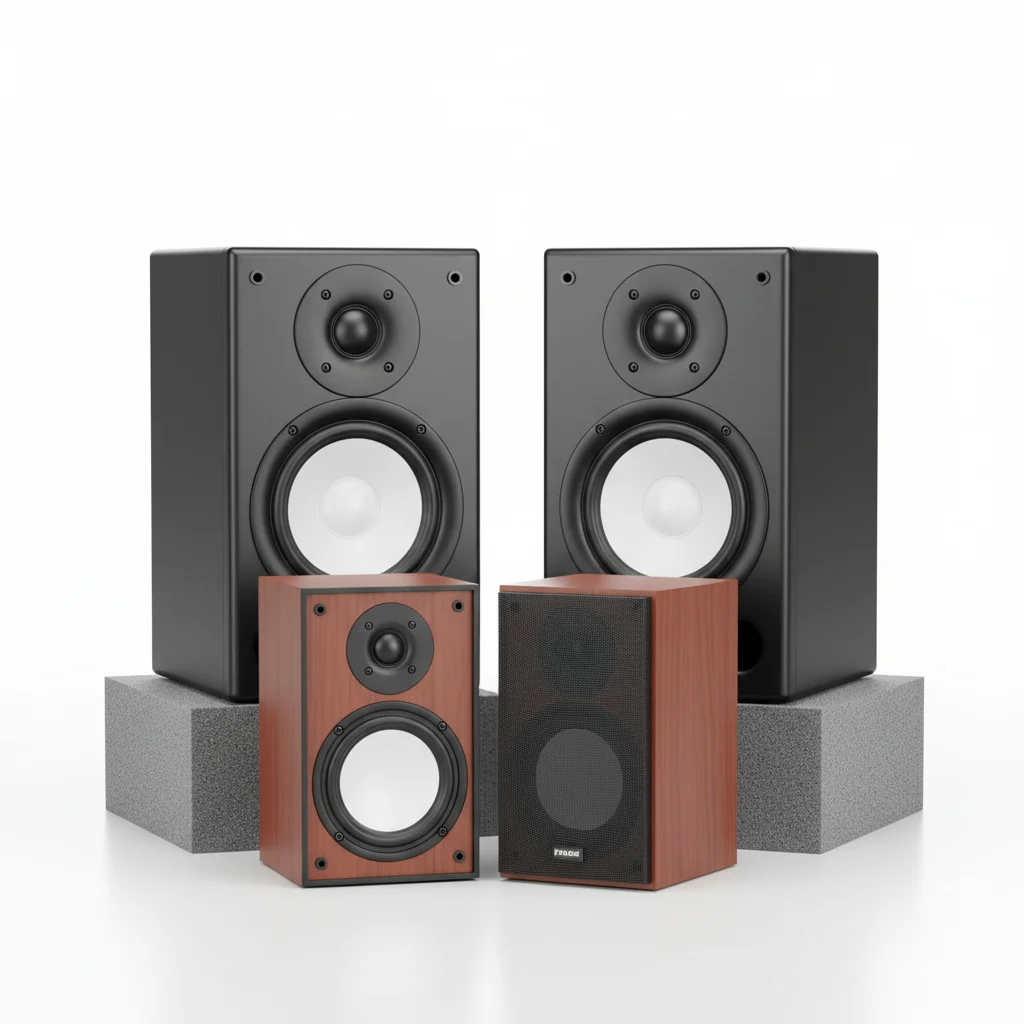
For critical listening and accurate mixing in audio production, studio monitors are unequivocally the superior choice due to their flat frequency response and transparent sound reproduction. Hi-fi speakers, while excellent for casual listening, are designed to enhance audio for enjoyment, often coloring the sound in ways that can mislead you during the production process. Studio monitors are engineered to provide an uncolored, accurate representation of your audio, allowing you to hear every detail and make precise adjustments, which is crucial for mixing and mastering.
Studio monitors are built to provide an uncolored, accurate representation of your audio, allowing you to hear every detail and make precise adjustments. This neutrality is crucial for mixing and mastering, where even subtle frequency imbalances can significantly impact the final product. Hi-fi speakers, on the other hand, often feature boosted bass or treble to create a more pleasing listening experience, which can lead to mixes that sound good on those specific speakers but translate poorly to other systems.
Understanding the Core Differences in Design
The fundamental difference between studio monitors and hi-fi speakers lies in their design philosophy. Studio monitors prioritize accuracy and a flat frequency response, meaning they reproduce sound as faithfully as possible without adding their own sonic signature. This is achieved through precise component matching, robust cabinet construction to minimize resonance, and often bi-amplification for better driver control. They are built to reveal flaws in your mix, not to mask them.
Hi-fi speakers, conversely, are designed for consumer enjoyment. Manufacturers often tune them to have a more “exciting” sound profile, which might include a scooped midrange, emphasized bass, or sparkling highs. While this makes music sound great for casual listening, it can be detrimental in a studio environment where you need to hear exactly what’s happening in your audio without any coloration.
Frequency Response and Transparency
The most critical aspect distinguishing studio monitors is their flat frequency response. This means that across the entire audible spectrum, from low bass to high treble, all frequencies are reproduced at roughly the same volume. This neutrality is vital for making informed mixing decisions, as it ensures that what you hear is an accurate representation of your audio.
Hi-fi speakers, while often having impressive frequency ranges, rarely aim for a flat response. They are typically designed with a specific sound signature in mind, which can make your mixes sound good on those speakers but potentially unbalanced on other playback systems. For instance, if your hi-fi speakers have an exaggerated bass response, you might inadvertently under-mix the bass in your track, leading to a weak low end when played elsewhere.
Transient Response and Detail
Studio monitors excel in transient response, which refers to their ability to accurately reproduce the initial attack and decay of sounds. This is crucial for hearing the punch of a kick drum, the snap of a snare, or the subtle nuances of a guitar pluck. A good transient response allows you to precisely shape the dynamics of your mix.
Hi-fi speakers, while capable of producing clear sound, may not offer the same level of transient detail. Their design often prioritizes a smooth, enjoyable sound over pinpoint accuracy, which can sometimes blur the edges of transient information. This can make it harder to identify and correct timing or dynamic issues in your audio.
Power and Amplification Considerations
Many studio monitors are active, meaning they have built-in amplifiers perfectly matched to their drivers. This ensures optimal performance and eliminates the need for external amplification. Passive studio monitors do exist, requiring a separate power amplifier, but active monitors are more common in modern home and project studios.
Hi-fi speakers are typically passive, requiring an external amplifier or receiver to power them. While this offers flexibility in choosing your amplification, it also introduces another variable that can influence the sound. Matching an amplifier to passive speakers can be a complex process to achieve optimal performance.
When to Choose Which Speaker Type
Here’s a quick guide to help you decide:
- Choose Studio Monitors if: You are involved in music production, mixing, mastering, sound design, or any activity requiring critical listening and accurate audio reproduction. You need to hear your audio exactly as it is, without coloration.
- Choose Hi-Fi Speakers if: Your primary goal is casual listening, enjoying music, or home theater. You prefer a more
Frequently Asked Questions
What is the main difference between studio monitors and hi-fi speakers?
The main difference is their design philosophy: studio monitors prioritize accuracy and a flat frequency response for critical listening, while hi-fi speakers are designed for consumer enjoyment with an enhanced sound profile. Studio monitors aim to reproduce sound faithfully without coloration, revealing flaws in a mix.
Why are studio monitors better for mixing and mastering?
Studio monitors are better for mixing and mastering because their flat frequency response ensures all frequencies are reproduced at roughly the same volume, providing an accurate representation of the audio. This neutrality is vital for making informed mixing decisions and preventing imbalances that could translate poorly to other systems.
Do hi-fi speakers have a flat frequency response?
No, hi-fi speakers rarely aim for a flat frequency response. They are typically designed with a specific sound signature, often featuring boosted bass or treble, to create a more pleasing listening experience. This coloration can make mixes sound good on those specific speakers but unbalanced elsewhere.
What is transient response and why is it important for audio production?
Transient response refers to a speaker's ability to accurately reproduce the initial attack and decay of sounds. It is crucial for audio production because it allows engineers to hear the punch of a kick drum or the snap of a snare, enabling precise shaping of dynamics and identification of timing issues.
Are studio monitors usually active or passive?
Many studio monitors are active, meaning they have built-in amplifiers perfectly matched to their drivers, ensuring optimal performance without external amplification. While passive studio monitors exist, active monitors are more common in modern home and project studios for their convenience and integrated design.
Choosing Between Studio Monitors and Hi-Fi Speakers
Decide whether studio monitors or hi-fi speakers are right for your audio needs based on your primary use case.
Determine if your main objective is critical audio production (mixing, mastering, sound design) or casual listening and home theater. This fundamental distinction guides your speaker choice.
If you need uncolored, accurate sound reproduction to reveal mix flaws, prioritize studio monitors. If you prefer an enhanced, pleasing sound for general music enjoyment, hi-fi speakers are more suitable.
For precise mixing decisions, a flat frequency response (studio monitors) is essential to ensure audio translates well across different systems. For casual listening, a specific sound signature (hi-fi speakers) can be more enjoyable.
Note that many studio monitors are active with built-in amplifiers, simplifying setup. Hi-fi speakers are typically passive and require a separate external amplifier, adding another component to consider.

As someone who does a lot of mastering, the emphasis on accurate sound reproduction was key for me. My old speakers were definitely enhancing the audio, which made it tough to catch subtle issues. With my new studio monitors, I can trust what I’m hearing, and it’s made a huge difference in the quality of my final masters. Highly recommend making the switch if you’re serious about your craft.
I was on the fence about upgrading from my old bookshelf speakers. The point about hi-fi speakers coloring the sound really resonated with me, as I often found my tracks sounding different on other systems. My new monitors give me a much more transparent sound, which has made mixing so much easier. I’m still getting used to the uncolored sound, but I can already tell it’s improving my workflow.
I’ve always used hi-fi speakers for my home studio, thinking they were good enough. After reading about the importance of a flat frequency response, I finally invested in a pair of studio monitors. The difference in my mixes is night and day! I can hear so much more detail now and my adjustments are far more precise. Definitely a game changer for anyone serious about audio production.
I picked up some entry-level studio monitors based on the advice here, hoping for a huge leap in my mixing accuracy. While they are definitely more neutral than my old hi-fi setup, I’m finding the bass response a little lacking for my taste. I might need to add a subwoofer down the line to get the full range I’m looking for. Still, for critical listening, they’re a step up.